

GPA Meaning is Grade Point Average. It means the point you have achieved in every course or standard. There are no international GPA standards. It varies from county to country and even varies between public and private universities of a nation. For example, in Bangladesh, the GPA calculation system is not equivalent in North South University (Private) and Dhaka University (Public). Actually, in universities, it is CGPA not GPA.
Education systems worldwide use various grading methods to evaluate students’ performance, knowledge, and skills. In Bangladesh, the most commonly used method in schools, colleges, and universities is the GPA system. GPA stands for Grade Point Average, and it plays a vital role in determining a student’s academic achievements and future opportunities.
What is GPA, and What is the Benefits of It?
In today’s world, more or less, we all are familiar with the term GPA. But fewer people know what GPA meaning is. GPA shows the academic performance of one’s. It accumulated the overall performance of the courses or subjects in class or a program. Suppose, in a country where GPA- 4 means Excellent, a student with GPA- 4 will get better opportunities and advantages in the job sectors.
A student with a good GPA will also get more opportunities in the schools and universities. They also get opportunities to take high-level courses and admit into top schools and universities across the world.
GPA System in Bangladesh
In Bangladesh, two types of GPA systems are available. One is GPA (Grade Point Average), and another is CGPA (Cumulative Grade Point Average). There is a difference between the school grading system and the university grading system.
Schools generally follow the GPA system, and the universities follow the CGPA system. There are also differences in public and private universities’ grading systems. One more thing is that all Private Universities do not follow the same grading system.
Grading System in Schools and Colleges
Grading system in school and colleges in Bangladesh is comparatively easier to understand. If a student gets 80-100 marks, then he or she gets A plus. Then A grade is from 70-79. After that, 60-69 is for A minus grade. Then 50-59 is B grade. Below is the comparative chart for the GPA meaning.
| 80-100 | A+ | 5.0 |
| 70–79 | A | 4.0 |
| 60-69 | A- | 3.5 |
| 50–59 | B | 3.0 |
| 40–49 | C | 2.0 |
| 33–39 | D | 1.0 |
| 0–32 | F | 0.0 |
✅ Passing Requirement: A student must achieve at least a Grade D (33% marks) in each subject to pass.
✅ Failing: If a student fails in one or more subjects, their overall result is considered Fail, regardless of GPA in other subjects.
How GPA is Calculated
The GPA is calculated using the following formula:

Example 1:
Suppose a student’s results are:
- Bangla → A+ (5.00)
- English → A (4.00)
- Math → A- (3.50)
- Science → A (4.00)
- Social Science → B (3.00)
Total Grade Points = 5.00 + 4.00 + 3.50 + 4.00 + 3.00 = 19.50
Number of Subjects = 5
GPA = 19.50 ÷ 5 = 3.90
Example 2:
If a student fails in one subject with F (0.00), then GPA is calculated as:
- Total Grade Points ÷ Number of Subjects → but since one subject is 0, overall GPA decreases drastically, and in most cases, the result is marked as Fail.
Check also: SSC GPA Calculator
GPA System in Universities of Bangladesh
While schools and colleges (SSC/HSC) use a 5-point GPA system, universities in Bangladesh often follow a 4.00 CGPA scale.
Example of University Grading (4-point scale):
| Marks Range | Letter Grade | Grade Point |
|---|---|---|
| 80–100 | A+ | 4.00 |
| 75–79 | A | 3.75 |
| 70–74 | A- | 3.50 |
| 65–69 | B+ | 3.25 |
| 60–64 | B | 3.00 |
| 55–59 | B- | 2.75 |
| 50–54 | C+ | 2.50 |
| 45–49 | C | 2.25 |
| 40–44 | D | 2.00 |
| 0–39 | F | 0.00 |
Thus, a university student’s CGPA is calculated by averaging the grade points across all completed courses.
To know how the GPA system works, it is vital to know about the GPA meaning. By understanding the GPA meaning, you will also get to know about the benefits of this system. After reading this article, we hope that you all are now clear about the meaning of GPA.
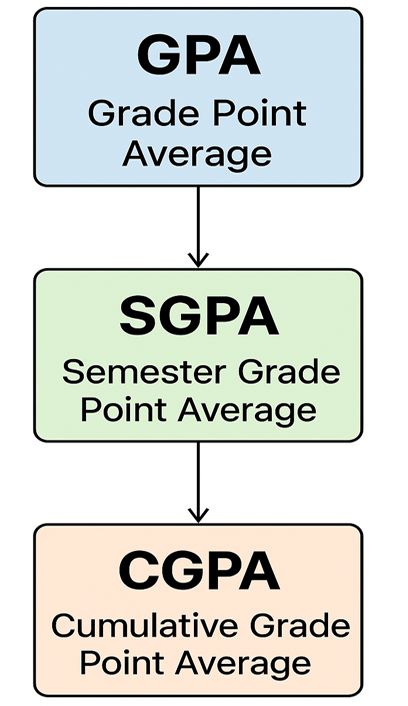
Difference Between GPA, CGPA, and SGPA
Here’s a clear comparison table showing the Difference Between GPA, CGPA, and SGPA:
| Feature | GPA (Grade Point Average) | CGPA (Cumulative Grade Point Average) | SGPA (Semester Grade Point Average) |
|---|---|---|---|
| Definition | Average grade points obtained in a specific exam, term, or year | Overall average grade points obtained throughout the entire academic program | Average grade points obtained in a single semester |
| Usage Level | Schools, colleges (SSC, HSC, Alim) | Universities and higher education | Universities with semester system |
| Time Frame | Short-term (exam or academic year) | Long-term (entire course/program) | Mid-term (one semester only) |
| Scale in Bangladesh | 0.00 – 5.00 (SSC/HSC) | 0.00 – 4.00 (Universities) | 0.00 – 4.00 (Universities) |
| Example | GPA in SSC: 4.80 | CGPA in 4-year degree: 3.70 | SGPA in 1st semester: 3.85 |
| Purpose | Shows performance in a specific period | Shows overall performance across all semesters/years | Shows semester-wise performance |
👉 In simple words:
- GPA = One exam/term result
- SGPA = One semester result
- CGPA = Overall result of the entire course/program
Conclusion
The GPA system in Bangladesh has become an integral part of the education sector. It provides a standardized way of assessing students’ academic achievements, making it easier to compare results across institutions. From SSC and HSC to university levels, GPA reflects performance in a simplified numerical form.
However, while it brings many advantages, the GPA system also has its drawbacks, especially in distinguishing top-performing students. Despite this, GPA remains a vital factor for higher education, scholarships, and career opportunities.
About Author