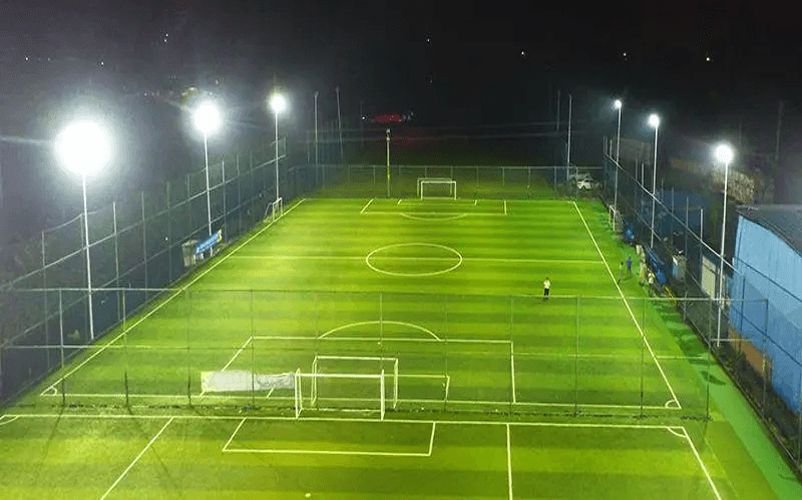

Where the argyles of twilight meet the ball game, and the twilight ends. When the floods lit by the sunshine flashed for the first evening of the 2024 season, the locals could hardly distinguish what marked the end of twilight and the beginning of the match.
Clean white gleamed the new solar-hybrid towers over the boundary rope, and due back to the stands came the families, and the practice time stretched, which had once again, when the day had ended. What was initially an experiment to revive life in a single village ground has now evolved into a working blueprint for rural sports in all of Maharashtra, not to mention beyond.
Light and Why It Matters in Cricket in Rural Areas
Prior to the solar makeover, the village field in Akluj was powered by 2 1 kW halogen light towers supplied by a five kVA generator. In December, sunset is at 17:48; by 18:15, the lux had reached as low as 80, which is far lower than the 300 lux considered by umpires to be the stage of safe pace bowling. Headaches from match days accumulated:
Overs left unplayed. Overs were cut to 14 single overs, with each ball counted 6 within the innings, should organisers fail to get the first ball delivered before 4:45 pm, shaving off nearly 30 % of match time in early-winter fixtures.
Safety frighteners. In 2023, two split lips were the result of the end of a fielding drill by medium-pacers in which a snick off the top-edge disappeared into gapped light, and the coach has banned all dusk training.
The attendance of even die-hard fans was sparse — generator drone and diesel smoke partially dissipated family audiences; the average gate was 520 on afternoon beginnings and 310 on evening games, business records published by the organizing staff showed.
That also hampered the training of the women’s development squad, who could only book the ground after the boys under-19 took their turn. Emission-free floodlights that were also night-ready offered the only way to provide all teams with an equal say over the crease. That equation was altered at the stroke of a scalpel when the upgrade was released at the launch of the Akluj Rural Championship in February 2024.
Energy Metrics & Payback
| Parameter | Pre-upgrade (Diesel Gen-set) | Solar-Hybrid System* | Notes |
| Power draw during play | 2 kW halogen | 2.4 kW LED (6 × 100 W) | LED towers deliver 350 lux in the field |
| Run time per match day | 4.5 h | 4.5 h | Two evening games + warm-ups |
| Energy used | 9 kWh | 10.8 kWh | Higher lux but still < 1 unit per tower-hour |
| Fuel/grid cost | 1.2 L diesel · h⁻¹ → ₹ 480 per match @ ₹ 92/L | ₹ 0 (solar) / ₹ 48 backup grid top-up | Grid tops up on overcast days |
| Annual fixtures | 42 | 42 | Season May – July |
| Operating expense | ₹ 20,160 | ₹ 2,016 | 90 % saving |
*12 kW PV array, 40 kWh LiFePO₄ battery, automatic grid bypass below 25 % state-of-charge.
Break-even clock
- Capital outlay: ₹ 9 lakh (twin 8 m solar towers, civil works, LiFePO₄ bank)
- Annual cash saving: ₹ 18,000
- Simple payback: < 5 years
Beyond the balance sheet, the switch trims about 3.9 t CO₂e each season (based on 0.84 kg CO₂/L diesel). Add quieter stands, zero fumes, and remote diagnostics that ping voltage or battery SOC to a phone app—features baked into the Zonstreet IoT tower spec—and the numbers tell only half the story. The brighter half unfolds every evening when the groundsman flicks his wrist, LEDs bloom across the boundary, and Akluj’s cricketers bat through every ball they earn.
Blueprint for Other Villages
Step 1 – Run a site-light audit
Measure current lux levels at three points: popping crease, mid-wicket, long-off. Anything below 300 lux during the final ten overs signals the need for LEDs. Mark shadow zones from trees or rooftops; south-facing poles often clear these without extra mast height.
Step 2 – Size the solar stack
Multiply target wattage by average match length plus 25 % buffer: a 2.4 kW LED array × 5 h ≈ 12 kWh. Add two days’ reserve to ride out monsoon cloud, so a 40 kWh LiFePO₄ bank meets most village schedules.
Step 3 – Pick a certified vendor
Short-list suppliers carrying BIS certification for both PV modules (IS 14286) and sport-grade LED drivers (IS 16108). Request a fatigue test report—10,000 on/off cycles—to avoid lumen droop during penalties or super-overs.
Step 4 – Stitch the funds together
Combine a state Rural Electrification Grant, a CSR pledge from any agro-processor within 25 km, and a community pot—players in Akluj sold ₹ 99 supporter badges to raise their final ₹ 1.8 lakh gap in under four weeks.
Step 5 – Lock the maintenance rhythm
- Bi-weekly: dry-wipe panels; clear bird droppings that can cut array output by 6 %.
- Monthly: download IoT logs, check battery depth-of-discharge hasn’t strayed beyond 80 %.
- Pre-monsoon: torque-check mast bolts, reseal junction boxes.
Step 6 – Track the payoff
Log fuel savings and crowd counts side by side. In Akluj, diesel spend fell to zero while average attendance climbed 34 % in the same quarter—metrics that make the next grant application almost write itself.
A village that lights its pitch with the sun does more than save rupees; it buys extra overs for every batter who once trained in the dark, and it invites a whole neighbourhood back to cheer them on. Copy the blueprint, keep the panels clean, and night cricket will bloom wherever the stumps stand.
About Author